Google, the one of the biggest tech conglomerates recently closed one of the biggest blind spots in organic search measurement. On 7 July 2026, Google announced, platform properties, a brand-new search console property type that shows how all your social media content on platforms like, Instagram, TikTok, X and YouTube performs in Google Search and Discover, right down to the exact queries people typed before finding your posts.
For years, brands could measure how a website performed in search but remained clueless on what happened when someone discovered your brand through a reel or a YouTube video in Google’s results. As we already spoke in our previous blog, How SEO Is Evolving as AI and Search Behaviour Change, discovery no longer starts and ends on your website and, now, for the first time, you can measure that shift in the same tool you already use for SEO.
In this blog, we explain what platform properties are, how to set them up, and five actions we recommend all Irish brands take this month.
What Are Platform Properties in Search Console?
Platform properties let you connect a social media or video account to Search Console and view its Google performance data, the same way you do for a website.
The data is query-level. You can see the actual Google searches that showcased your TikTok video or Instagram reel.
Each connected platform gets its own property with three reports:
| Report | What it tells you? |
|---|---|
| Performance | Clicks, impressions, CTR and average position, filterable by individual post and search query |
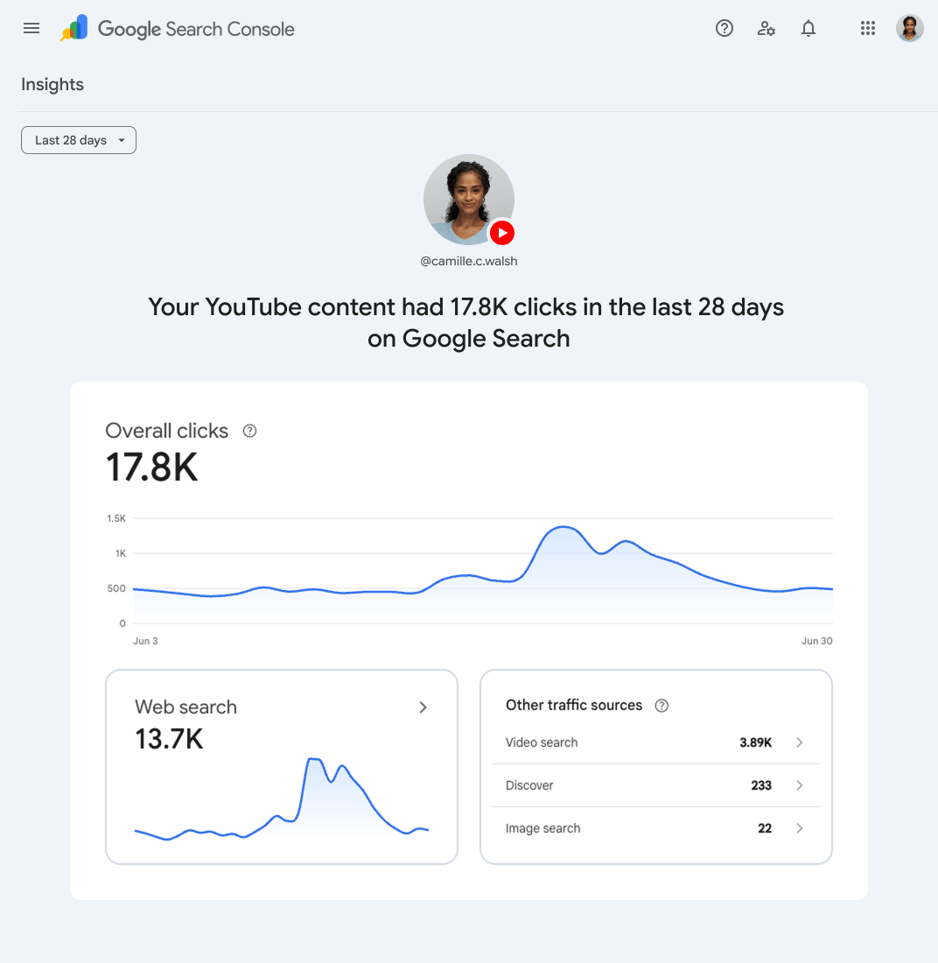
| Insights | Traffic trends, top-performing posts and how people discover your account on Google |
| Achievements | Growth milestones, such as reaching a new clicks threshold over 28 days |
Platform properties give you a clearer view of how your social and video content performs across Google Search, Discover, Images and Video.
Can You Use Google Search Console Without a Website?
Yes. Search Console previously required a verified domain or URL prefix, but platform properties let you verify an Instagram, TikTok, X or YouTube account directly, with no website needed.
As Search Engine Journal notes, the feature is available even to creators who have never had a verified site. If your brand’s presence lives on social or video platforms, Search Console is finally a tool you can and must use.
How Do You Set Up a Platform Property?
- In Search Console, open the property selector dropdown and click “Add property.”
- Select one of the four supported platforms: Instagram, TikTok, X or YouTube.
- Follow the onscreen verification steps to authorise the connection to your account.
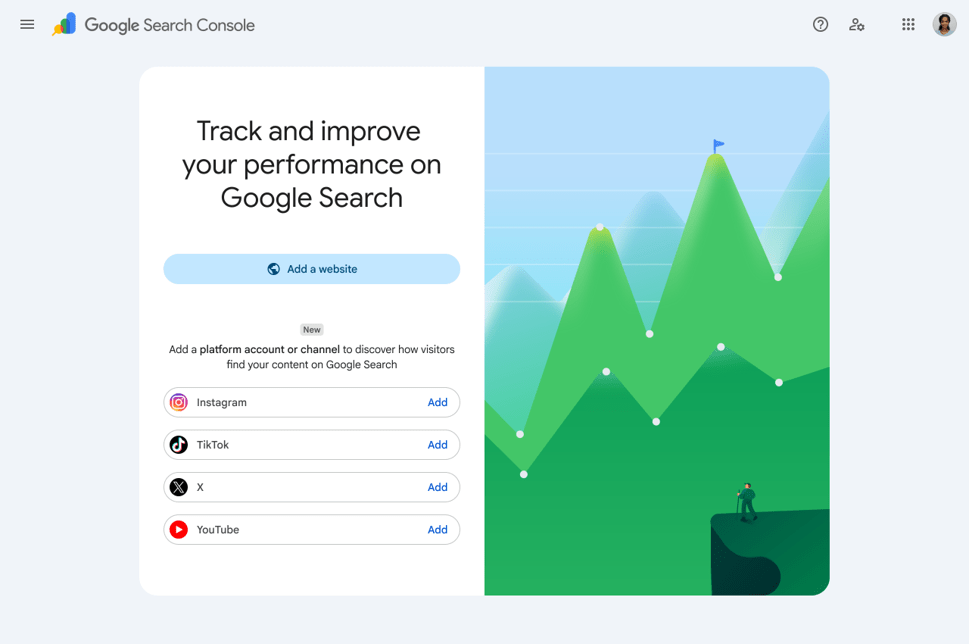
Extra tip: This feature will be rolled out gradually over the coming weeks, so the option may not be visible in your account yet. Check back regularly. You want data collecting from day one, even for smaller channels.
Does Search Console Track Your Social Media Performance?
Only on Google surfaces and it generates platform properties report on search, discover and news. It does not track native metrics such as TikTok views; Instagram likes or YouTube watch time from the home feed.
A few examples of how the metrics work:
- If your Instagram Story appears in Google search results, it counts as an impression. If someone clicks it, that is a click.
- If your video appears in results or discovers and someone clicks it, the click is counted even if it opens in Google’s own viewer.
Think of platform properties as a new lens on Google discovery that sits alongside your native social reporting rather than replacing it. It is also separate from ‘Search’ profiles, the public creator pages Google launched earlier in 2026. Platform properties are purely analytics.
Why Does This Matter for Irish Brands?
With this update, Google formally acknowledged that visibility no longer lives on your website alone. People discover brands through short-form video, social posts and AI-generated answers, a shift that help clients quantify through measuring brand visibility in AI search.
In practice:
- A hotel can now see whether its Instagram Reels appear when people search its name or “hotels in Galway” and measure Discover traffic to that content.
- A retailer can identify which product-led TikToks earn more Google impressions and turn those topics into landing pages or blog content.
- A B2B brand can show leadership that its YouTube explainers contribute to search visibility, not just channel views.
What this really confirms is that SEO is no longer a website-only discipline but it’s also now a core part of your social strategy. Every caption, video title and post description is metadata that Google can read, rank and showcase, which means the keyword research, search intent and optimisation principles we apply to web pages now also apply to your social content.
Brands that plan social content with search demand in mind rather than treating social and SEO as separate channels will be the ones that appear wherever their audience is looking. Social content is now, measurably, a search asset, and it deserves the same optimisation discipline as a web page.
What Should You Do with This Data?
Here are the five actions we recommend taking this month:
1. Verify all four platforms as soon as the option appears. Even small channels. Baseline data starts the day you connect.
2. Review the Queries tab weekly. The searches surfacing your social posts are free audience research. Look for recurring themes, not one-offs.
3. Feed winners back into your content strategy. If a 30-second Reel is earning impressions for a high-intent query, that topic deserves a blog post, a landing page, or a video series.
4. Optimise your social copy for search. Write captions and video titles the way people search, keep your brand name and location consistent across every profile, and treat descriptions and hashtags as metadata. This is a core part of the SEO services we deliver for clients, extended to social channels.
5. Add a social search section to your reporting. Organic visibility reports that ignore social discovery are now incomplete. At Core Optimisation, we are incorporating platform property data into our measurement dashboards so clients see website, social and AI visibility in one clear report.
Start Measuring Your Social Search Visibility Now
You do not need to wait until you have months of data to benefit from platform properties. The brands that connect their accounts early will know which social content Google is already surfacing, which queries are driving discovery, and where the gaps are, before their competitors do.
Need help joining up your search, social and AI visibility? Get in touch with our team today.