Why One Search Matters Today
Customer journeys are non‑linear. People move seamlessly between ads, organic results, reviews, social content, blogs and even AI-generated answers in making their decision to buy. They don’t think in channels – they think in outcomes. Yet many organisations still run paid search, SEO and content marketing in silos.
This fragmentation leads to inconsistent messaging, higher costs and missed opportunities. The One Search approach – aligning paid, organic and content into a single strategy creates a unified customer experience & stronger visibility.
Let’s look at how leading businesses are bringing these disciplines together, and what an effective One Search strategy looks like.
The Shift Towards a One Search Ecosystem
Search Is Now Blended – So Strategy Should Be Too
Search has fundamentally changed. The modern results page is no longer a list of “10 blue links.” It’s a dynamic, blended environment with multiple features: ads, organic listings, product tiles, map results, FAQs, videos, & AI generated‑ summaries. All competing for a customer’s attention.
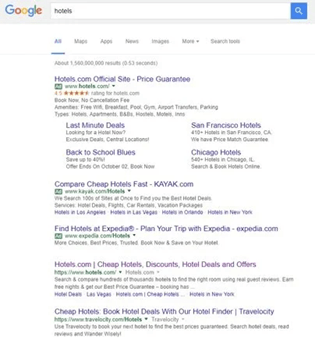
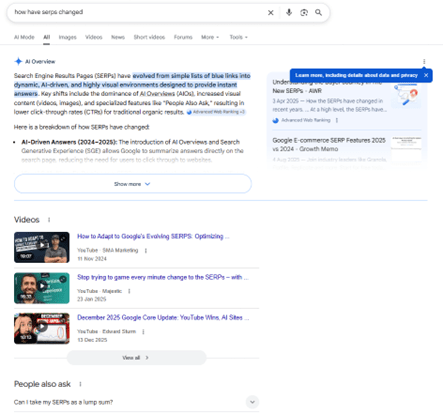
Consumers don’t distinguish between PPC, SEO or other content: they simply click what’s most useful. This has direct implications for how brands perform. When PPC, SEO and content creation operate in silos, visibility becomes inconsistent, work is duplicated, Messaging becomes fragmented, and investment becomes inefficient. You might perform well in one part of the SERP while leaving gaps elsewhere.
A one‑search approach changes that. Paid and organic stop competing and start reinforcing each other. PPC captures immediate, high‑intent demand while SEO builds long‑term authority and trust.
Together, they secure more of the results page, support each other’s performance, create a smoother user journey, and ensure every ad euro is spent wisely.
Shared Keyword Intelligence Drives Smarter Decisions
One of the most powerful advantages of a One Search model is shared intelligence. Paid search offers rapid, high‑quality performance data: which queries convert, which waste budget, where competitors are aggressive, and where customer intent is shifting. These signals emerge within days.
SEO data, on the other hand, provides long‑term insights: broader demand trends, multi‑month ranking patterns, gaps in content coverage, and sustainable opportunities for organic growth.
Unified teams bring these two perspectives together into a single keyword universe. Instead of separate lists, conflicting priorities or duplicated work, PPC insights shape SEO content strategy, and SEO outputs directly enhance PPC performance by improving landing‑page relevance and Quality Score.
The commercial impact is measurable:
- Higher conversion rates driven by more aligned user journeys
- Lower CPCs as Quality Score improves
- More efficient and effective content investment
- Faster organic ranking improvements supported by PPC demand signals
- Stronger New-Customer-Acquisition figures from smarter spend
This integrated dataset not only reduces waste but also enables businesses to prioritise content and invest where it can deliver the greatest impact across all channels.
Content Is No Longer a Supporting Player – It’s the Strategic Centre
Content now underpins every stage of the search ecosystem. It shapes organic rankings, dictates PPC ad relevance, influences Quality Score, feeds Performance Max creative, supports social engagement, and drives retargeting and email automation.
In a One Search structure, content is not a standalone function or a blogging activity. It becomes the strategic centre of the entire search experience. Every article, landing page, guide or video plays a defined role in discovery, consideration or conversion.
Brands that elevate content to this central position see stronger omnichannel performance, greater creative consistency and more stable long‑term growth.
What One Search Looks Like in Practice
Consistent Messaging Across Every Channel
Siloed teams often produce fragmented messaging: PPC ads emphasise one benefit, SEO pages highlight another, and blog content goes in an entirely different direction. This inconsistency erodes trust and reduces conversion rates.
One Search solves this by aligning:
- Value propositions
- Headlines and calls‑to‑action
- Content themes
- Tone of voice
- Brand narrative
The result is a unified user experience across all touchpoints, increasing confidence and improving conversion throughout the funnel.
Content Prioritised Using Real Performance Data
Allow performance data to dictate content creation and optimisation.
For Example:
- PPC search‑term reports to uncover real user language
- Organic ranking and CTR data to prioritise high‑value pages
- Landing‑page metrics to identify friction
- On‑site search to highlight unmet needs
- Social comments and reviews to expose pain points
- Competitor gaps to inform new opportunities
Every content piece has a job: to rank, to convert, to educate, or to fill gaps in the user journey. This ensures resources are used where they drive measurable commercial outcomes.
PPC Supporting SEO – and SEO Supporting PPC
Advanced marketing focuses on total incremental visibility, not channel cannibalisation. Data across industries shows:
- Running paid ads on strong, generic, organic terms increases total clicks rather than redistributing them
- Reducing spend on Brand can improve organic conversion rates
- High‑ranking organic content improves paid conversion rates
- Paid activity protects visibility during SEO volatility
- SEO reduces long‑term reliance on rising CPCs
These synergies compound over time, enhancing both efficiency and growth.
Full‑Funnel Omnichannel Journeys Aligned to User Intent
A One Search strategy connects every layer of the funnel into a cohesive sequence:
- Discovery: Social content, video, top‑funnel messaging
- Interest: Non‑brand search, SEO landing pages
- Consideration: Comparison content, product detail, retargeting
- Conversion: Brand search, shopping ads, email nudges
- Post‑purchase: Content‑driven nurturing, retention and loyalty
Rather than managing channels independently, businesses create a flexible system that adapts to behaviour and intent.
The Commercial Impact of One Search
Adopting a One Search model typically leads to:
- Higher efficiency and lower costs through improved Quality Score and content‑rich landing pages
- Stronger organic performance driven by PPC‑informed SEO priorities
- Higher conversion rates due to consistent messaging and improved user experience
- More scalable growth, where paid accelerates demand and SEO sustains it
- Better cross‑functional collaboration, reducing duplication and aligning teams around outcomes instead of channels
Using this approach for one of our clients in Core Optimisation: we achieved a 4% reduction in spend, 61% growth in revenue and 41% growth in new customers YoY.
Embracing the Future of Omnichannel Search
Search has become a blended environment where ads, organic results, product tiles, maps, videos and AI answers compete for the same user attention. Customers don’t differentiate between channels: they choose the most useful result. Organisations that still separate paid search, SEO, and content risk duplicated work and inefficient spend.
A One Search model unifies these disciplines. Shared keyword intelligence aligns PPC’s real‑time demand signals with SEO’s long‑term opportunities. Content becomes the strategic centre, improving Quality Score, conversion rates and overall visibility.
The outcome is a consistent, data‑driven search ecosystem where paid and organic reinforce one another, unlocking stronger ROI, scalable growth, smarter spends, and clearer decision‑making across the funnel.
References:
https://developers.google.com/search
https://www.thinkwithgoogle.com
https://www.searchenginejournal.com